What is Marcescence?
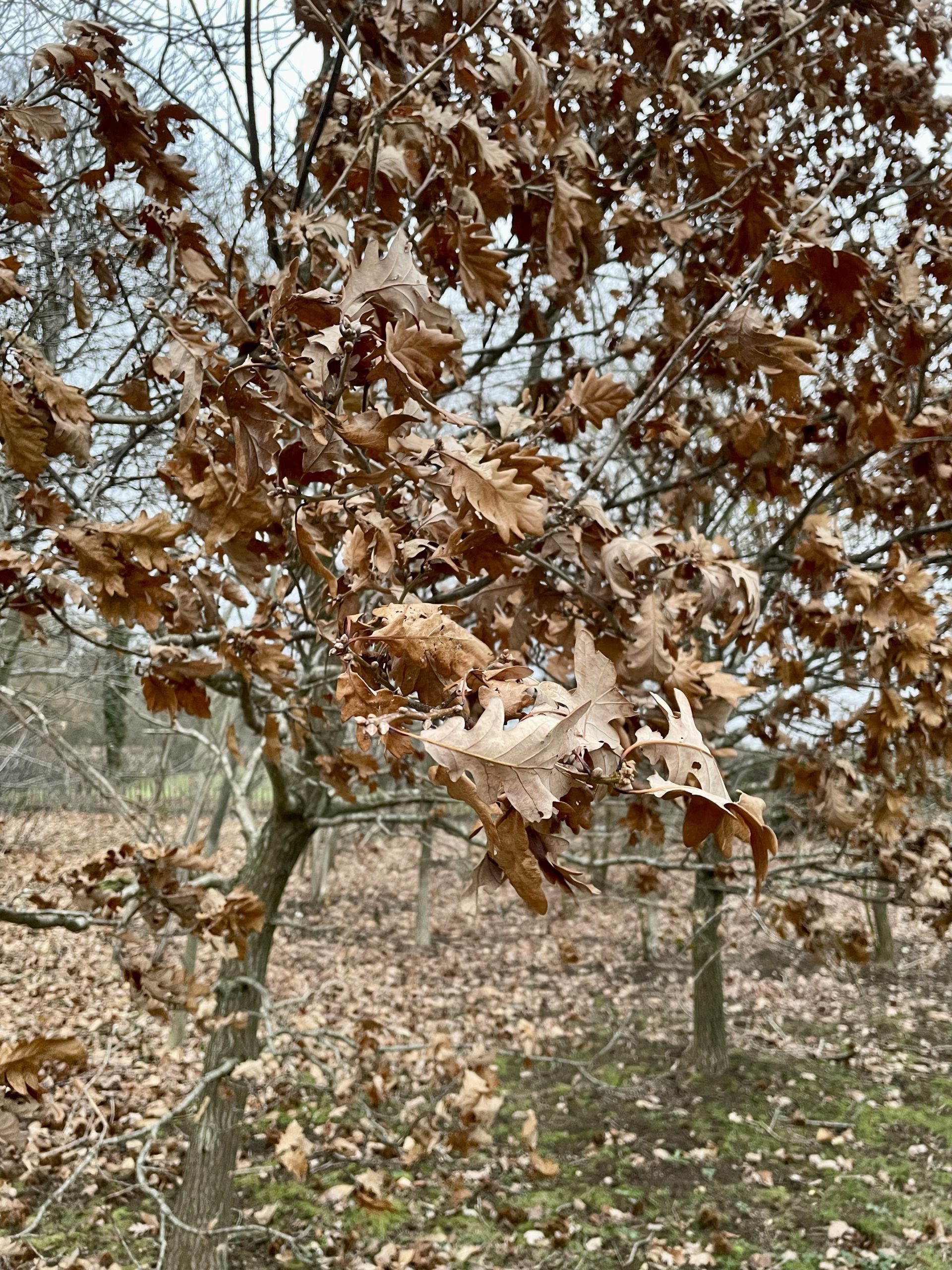
Marcescence is the holding on to dead leaves and dead plant material during winter. This happens to particular species of deciduous trees such as beech and oak (this is a bit peculiar as the word deciduous comes from the latin for falling off, more on that later).

What Usually Happens?
In the Autumn the leaves of deciduous trees undergo many changes. The chlorophyll is lost, the leaves stop making sugars, and the there is a change in plant hormone levels. This a signal to the base of the leaf stalk to start to seal up. This is done with a corky like layer which protects the scar left as the leaves drop, preventing infection. In marcescent trees this process is incomplete and the leaves remain attached, although in some cases tenuously, these leaves are then pushed off in the spring by new growth.
What’s Going on Here?
One of the reasons trees lose their leaves in winter is to protect themselves from storm damage. So what are the reasons for this marcestent trait? Well, there are some clues, the age of the tree or part of the tree appear to be important; as young trees or young parts of the tree seem to exhibit increased marcescence. Although there is no clear and proven reason that explains marcescence, so the answer is not sure.
Theories for Marcescence
Defence
It may help to protect their buds from browsing herbivores; the marcescent leaf hides the new buds which are a food source for these herbivores. It has also been suggested that the herbivores may nibble and taste the dry leaves. The leaves are bitter due to certain chemicals which are present in them, this may encourage the animal learn to leave this plant alone.
Protection
It could be to protect the young growth from frost as having the leaves present shields the new buds, or it may enable the trapping of deep snow as these trees often grow on dry sites; having a little extra water from snow melt may help kickstart their growth in spring.
Nutrient Recycling
Another reason could be a means of increasing nutrient recycling as by keeping the leaves until the spring when they do fall, they can form a mulch and be broken down supplying nutrients as well as keeping the base of the trees moist, as mentioned previously, these trees often grow on dry sites these sites are often nutrient poor as well. It has been shown that by holding onto the leaves there is an increase in photo degradation, this is important as some marcescent species leaves do not decompose well and the extra light may make the eventual decomposition easier (due to aromatic compounds).
It could also be that by dropping the leaves in spring with the extra warmth the decomposition process by fungi and bacteria would be quicker and it may also be useful to fungi that may then be beneficial for the growing tree.
Something else?
Or it could be a mixture of all the mentioned theories or may be something else not yet looked at. As I mentioned at the beginning, these trees are meant to be deciduous losing their leaves and in the main there do, but both beech and oak are related and some of their other relations are not deciduous, so marcescence could be an in-between stage, as these trees have not gone completely down the deciduous route it may be a vestigial trait.
Marcesent trees can provide a protective winter habitat for birds, as well as having benefit for invertebrates giving them access to places to overwinter. As well as being pleasing to look at and listen to for us when the wind blows in the winter forest.