

The Sierra Nevada Mountains of Southern Spain written by IMLs Michael Hunt & Jane Livingstone
The Sierra Nevada is home to the highest mountain in mainland Spain, Mulhacén (3479m). We had been visiting Spain to climb for many years and bought a house on the southern slopes known as La Alpujarra in 2002. At that time we were looking for a base for our own holidays, it was a year later when the idea of leading people walking in the Sierra formed. So we trained to become Mountain Leaders and IMLs and now we work as “Sierra Nevada Guides.”
The Sierra Nevada is Spain’s largest national Park and is surrounded by a natural park. Combined, the parks have a massive altitude range from 680m up to 3479m. There are several different climatic zones bringing a huge variation of biodiversity and the national park alone has 77 endemic species.

From the foothills through to the summits, this is a walker’s paradise with pretty villages and medieval trails. Apart from the 2 highest summits (Mulhacén and Veleta 3396m), both of which are quite accessible, and a few popular paths, you can spend a day walking and not meet anyone. There are 26 named peaks over 3000m. Mulhacén is named after the penultimate Arab ruler of Al Andalus, “Muley Hacen” who is reputedly buried on the mountain.
Combined with La Alpujarra and the Val de Lecrin, the Sierra Nevada provides a good base for walking from March through until October. Outside of these times the weather and conditions are variable. However the high tops can provide some superb winter mountaineering and climbing.
We tend to work mainly in the western half of the Sierra Nevada as this is where the higher peaks are. In this part of the range there are 2 refuges providing the usual dormitory style accommodation and food, but importantly there are 8 unmanned shelters and 2 rock shelters making this a pretty cheap place for a tour.
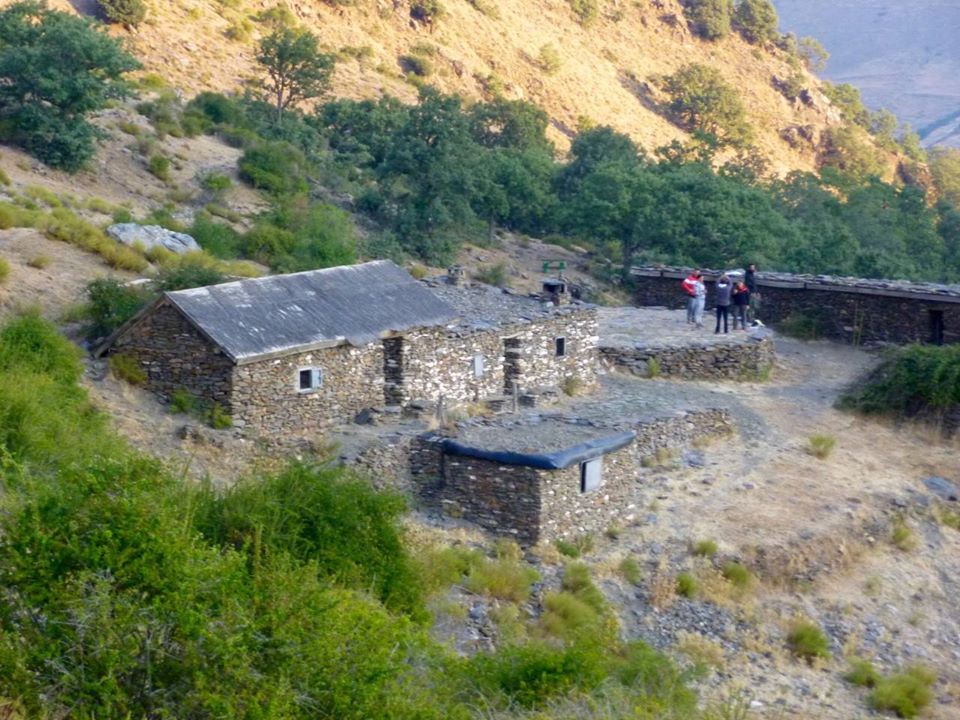
Camping is allowed (with some restrictions) in the National Park.
The National Park operate a bus services from Capileira (south side) and Hoya de la Mora (north side) to help people ascend Mulhacén and Veleta. These are useful for us too as we can explore some of the more inaccessible peaks without carrying overnight gear.
When ordering a drink at a bar in Granada Province it is customary to be served with a complimentary “tapa” free of charge between 12 and 4pm and after 8pm. With each drink you get a different tapa so order a small beer rather than a large one and keep the beer and tapa flowing!
In winter the high mountains of the Sierra Nevada become a whole different proposition. We refer to them as like Cairngorm with altitude. Lower down there is often good snowshoeing, though this varies from year to year and can’t be relied on. Lower still between the villages of La Alpujarra and the Val de Lecrin there is superb hill walking to be had.
How easy is it to get to?
The Sierra Nevada is very accessible. Granada (famous for the Alhambra Palace) is the nearest city and there are Easyjet flights from both Manchester and Gatwick. Also BA flies from London City. Car Hire is sometimes expensive at Granada. Malaga Airport, which has regular flights from virtually everywhere in Europe, is only a 2 hour drive away and has cheap car hire. There are buses from both airports to Granada and from Granada to the mountains. For a first visit, the village of Capileira is a good starting point although if you have a car, Lanjaron gives you more options. Unless you are thinking of a tour through the mountains, having a car gives you more choices.

Can you tell us about the most memorable moment of a recent trip?
This summer, we were touring in the mountains, and arrived at one of the bivouac refuges to find another big group had got there first. We were directed to a lovely tiny alternative with it’s own sleeping platform and table, which we had to ourselves to watch the sun go down over the mountains, magical!
What are your top tips for anyone travelling to this area?
Don’t think it will be too hot in summer! At 3000m it is often only 14 to 18 degrees in the height of summer. However it will be much hotter back down in the valley so find accommodation with a pool for June, July, August and September.
You would be unlucky to get much rain from mid June through to the end of August, but the winds can get very strong. A lightweight waterproof / windproof is normally o.k.
Water can be a big issue in summer, particularly if there has been a dry winter, so you need to be prepared to carry plenty.
What else is there to do, other than mountaineering, in this area?
The nearest bit of coast is known as the Costa Tropical. A visit to the beach and lunch in one of the “chiringuitos” (beach bars) is a great rest day. A lunchtime “menu del dia” of 3 courses, bread and a drink can still be found for 10 Euros. There are lakes and rock pools to swim and cool off in too. Mountain biking, horse riding, canyoning and water sports are all available locally.
Are there any dangers or annoyances here?
The national park sometimes cancel the busses (uplift) at quite short notice meaning that despite a booking you have to re-arrange your itinerary with clients. Sometime (understandably) for weather but also a range of other reasons.
What one piece of kit could you not manage without on a trip like this?
My buff, definitely – I use if for sun protection in the summer and keeping the wind out. A more recent discovery is an Aquapure Traveller water bottle with filter; makes getting water so much easier somewhere where it is often scarce.

How do people contact you if they want to find out more?
We are always happy to chat to and advise people who are planning to visit the area. There is a section on our website to help people with some basic info about the area.
https://sierranevadaguides.co.uk/information-about-the-sie…/
Michael Hunt & Jane Livingstone
info@sierranevadaguides.co.uk
Thank you Michael and Jane!
