
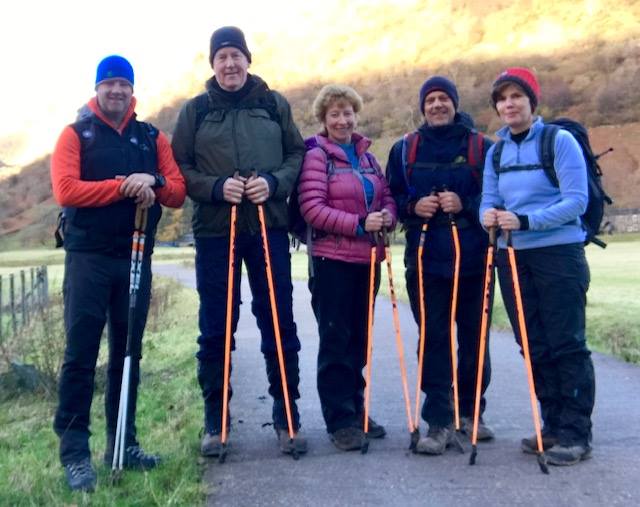
We often get asked about the best kit for a walk in the cold weather. So, we asked IML Steve Ellis to talk to us about layering.
Steve Ellis is an International Mountain Leader and owner of Gemini Outdoor. He is also a Nordic Walking National Coach and has lead trips across the UK and further afield with private clients and his group of Nordic Walkers.
What should I wear in winter on our mountain walks?
At this time of year, I get asked a lot “what should I wear on our winter mountain walks?”…
The answer is simple – “a system of layers!” But what does that actually mean? Think of three distinct layers:
1) Base layer (that which is next to the skin) – The purpose of a base layer is to wick (take) moisture away from the skin.
2) Mid layer – this layer is designed to retain warmth, and keep out the cold.
3) Outer layer – keeping out the elements (rain, snow etc) is this layer’s primary purpose.
Just the smallest drop in your core temperature can lead to all sorts of problems further along your walking route; hence, a layering system will help you be comfortable and aid thermal regulation. When you are out and working hard you will inevitabley perspire; thus, taking moisture (perspiration) away from the skin is paramount to regulating ones core temperature. Next to your skin, you need a base layer that ‘wicks’ that moisture away and doesn’t retain it. This is of utmost importance. Some materials retain moisture and should be avoided; however, Merino wool t-shirts and long sleeved tops are definitely worth considering; not only do they do the ‘wicking’ job, they also contain properties that neutralize the odour effects of perspiration, which are ideal for single or lightweight multi-day treks.
Your mid-layer could comprise of a lightweight fleece or smock, or perhaps a gilet (sleeveless jacket) – anything that is, ideally, lightweight and performs the functions of retaining your core warmth and keeping out the biting effects of wind chill.
When the heavens open and the winds pick up, the outer shell is the garment that is going to keep out the elements. This can be the difference between a truly positive and memorable experience or a truly miserable day out!
Everyone, quite rightly, has their own take on what is great kit and all ideas are worth considering before you commit to purchasing. Here are a few things to consider; you have to be comfortable, you need to enjoy your walk and keep buying kit within your budget.
For years I wore various permutations of kit and probably (no, definitely) spent a fortune until I understood what was right for me.
Nowadays, and with experience under my belt, I have my ‘go-to kit’, and yes, I may look the same everyday, but I know its works for me. I wear Icebreaker or Rab Merino base layer(s), a Rab micro hoody, a Marmot lightweight gilet, and Rab micro duvet jacket or Rab waterproof jacket and trousers. For additional weather protection and warmth, I may put on a Rab Event jacket (lightweight). On my legs, I either wear Rab or Simond shell trousers, or in snow and/or rain, Rab or Simond salopettes with merino long johns if it’s really cold!.
Looking after my extremities is also very important. My feet are kept warm and dry with mid-calf Sealskinz socks, and, when needed, Paramo ankle gaiters for further protection when I know I’ll face waterlogged or boggy areas leading to the slopes on my journey! I’ve tried long socks and gaiters and found that I prefer the shorter versions but it comes down to personal preference! I always carry a woolly hat and have available Sealskinz, Rab or Marmot gloves. Looking after my head and hands is essential and the kit selections are there to regulate temperature by simply adding or removing as my body requires. I also carry a buff as it’s a versatile garment (neck warmer or balaclava) and ideal for keeping out the draughts. furthermore, to ensure I can see during white-outs and when the winds and sleet are so biting they sting your eyes, I have my ski goggles.
To complete the winter kit, for the past 10 years I’ve used the same winter boots, either La Sportiva S Evo Trango GTX or, Scarpa Manta. Both have a high supporting ankle fit, are super comfy, relatively lightweight, have aggressive tread patterns and are resistant to the rigours of the winter environment. I find that both are great for everyday use as well as in serious cold, snow and whilst using snowshoes (and crampons).
As important as the boots is what is inside them. Each new pair of boots gets treated to a new pair of Superfeet insoles, not just because they are super comfy, but they are also designed to help with pronation and supernation issues.
Finally, on my back and regardless of whatever rucksack I’m using, my kit is kept dry through the use of dry bags. I have a rucksack sized one, with a range of differently coloured and sized dry bags inside with various items stowed; keeping with the ‘keep things dry theme’, my maps are ready to use in water-tight map cases along with my mobile phone.
I hope this helps and at the end of the day, assess the conditions you are likely to face and plan your journey and layers accordingly. Ask around, select wisely, get what you can afford and most importantly enjoy your hill time.
